Discover what bathroom remodels actually cost in Nassau County, NY—from 5x7 bathrooms to full renovations, including materials, labor, permits, and hidden expenses you need to plan for.
You’ve been staring at that outdated bathroom for months. The tile’s cracked, the grout’s turning colors you didn’t know existed, and the vanity looks like it time-traveled from 1987. You’re ready to do something about it, but here’s what stops most Nassau County homeowners in their tracks: What’s this actually going to cost?
Not the vague “it depends” answer you’ll find everywhere else. Real numbers. Honest breakdowns. The kind of pricing transparency that lets you plan without wondering if you’re about to blow your budget on surprises no one mentioned.
That’s exactly what you’re getting here. Let’s talk about what bathroom remodels actually cost in Nassau County in 2026, from compact 5×7 spaces to full-scale renovations, and what you need to know before the first tile gets pulled.
In Nassau County, you’re looking at $8,600 to $50,600 for a full bathroom remodel, with most homeowners landing somewhere around $18,500. That’s higher than the national average, and there’s a reason: Long Island labor costs, strict permit requirements, and the reality that many homes here were built decades ago with plumbing and electrical that needs updating.
The range is wide because “bathroom remodel” means different things. A basic refresh where you’re swapping fixtures and updating finishes sits on the lower end. A complete gut job where you’re moving walls, relocating plumbing, and installing custom everything? That’s pushing the upper limit and beyond.
Here’s what matters: size, scope, and materials. A 40-square-foot bathroom runs around $370 per square foot on average, but that number shifts based on whether you’re keeping the existing layout or changing it, using standard fixtures or premium ones, and how much of the work requires licensed pros versus cosmetic updates you might tackle yourself.
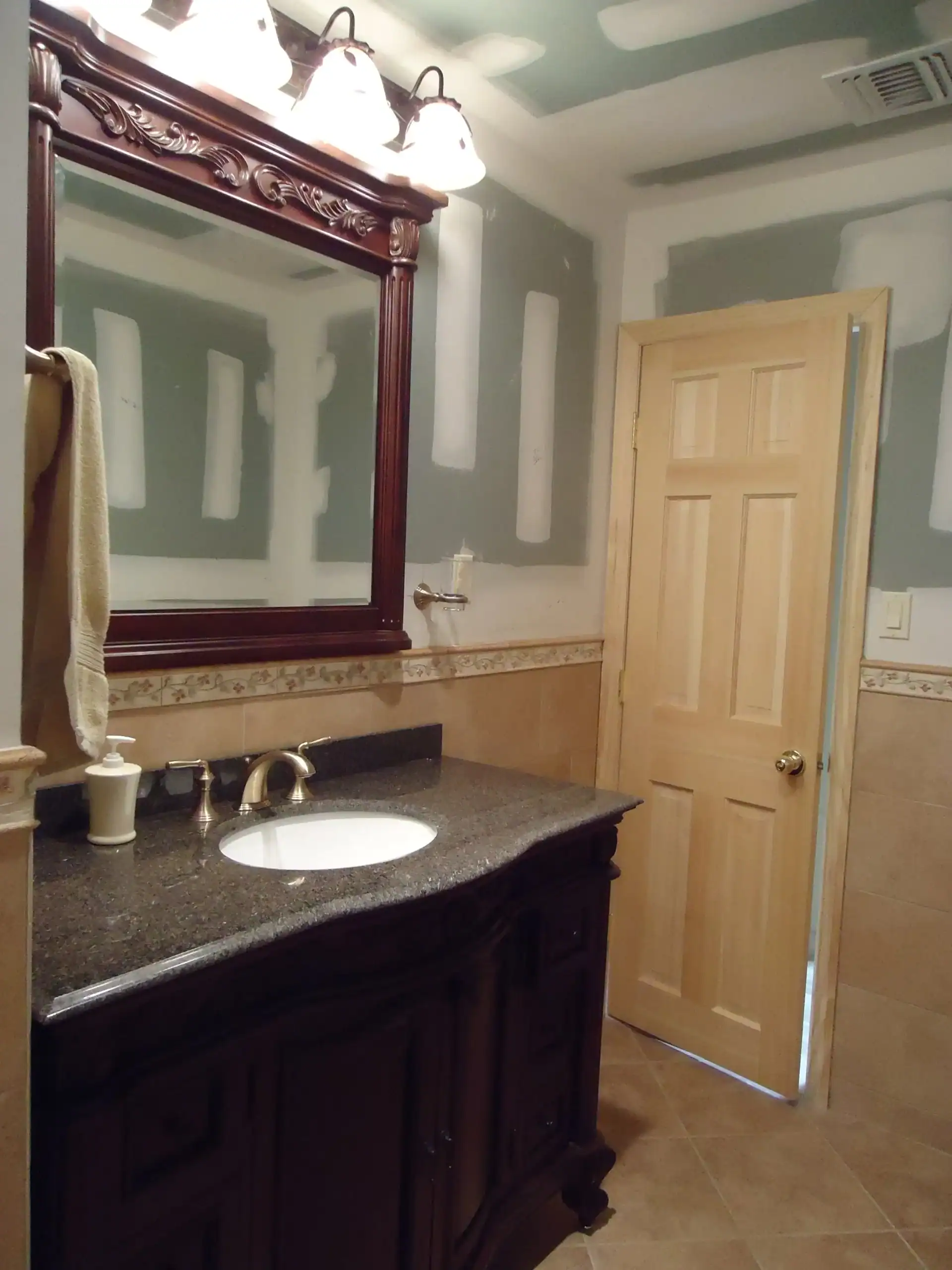
A 5×7 bathroom gives you 35 square feet to work with. It’s one of the most common sizes for a full bathroom, and the good news is that smaller doesn’t always mean cheaper per square foot, but it does mean lower total costs than larger spaces.
For a basic 5×7 bathroom remodel in Nassau County, you’re looking at $3,500 to $7,000. That covers a new toilet, a small tub or shower, a sink, and basic fixtures. You’re not moving plumbing or doing anything structural, just replacing what’s there with newer versions.
Step up to a mid-range remodel and you’re in the $8,000 to $12,000 range. Now you’re talking better quality fixtures, maybe some tile work, updated lighting, and a vanity that doesn’t look like it came from a big-box clearance rack. The space starts feeling intentional instead of just functional.
Here’s what drives the cost in smaller bathrooms: labor. Contractors actually charge more per square foot for compact spaces because everything takes longer when you’re working in tight quarters. Tile cuts need to be more precise. Fixtures require careful maneuvering. Every measurement matters more.
Materials for a 5×7 bathroom won’t break the bank. You’re not covering massive square footage. But labor? That’s where 35-50% of your budget goes. Plumbing work, tile installation, electrical updates—all of it takes skilled hands, and skilled hands don’t come cheap on Long Island.
One more thing: if you’re keeping the existing layout, meaning your toilet, sink, and shower stay in the same spots, you’ll save thousands. The minute you start moving plumbing lines or relocating fixtures, you’re adding $1,000 to $5,000 to the project. Sometimes it’s worth it for better flow. Sometimes it’s not. That’s a call only you can make based on how you actually use the space.
Retiling is one of those projects that looks straightforward until you start pricing it out. In Nassau County, you’re looking at an average of $2,000 for a standard bathroom retiling job, but that number swings anywhere from $450 to $10,000 depending on what you’re tiling and what you’re tiling it with.
Let’s break it down by area. Bathroom floors typically run $400 to $8,000 depending on size and tile choice. Ceramic and porcelain are your budget-friendly options at $2 to $15 per square foot for materials. Natural stone like marble? That’s $10 to $50 per square foot before anyone even picks up a trowel. Then you’re adding labor at $8 to $20 per square foot, and suddenly that floor is a significant line item.
Shower retiling is where costs climb fast. You’re looking at $800 to $3,000 for shower walls and floor combined. Why more expensive? Waterproofing. Showers are high-moisture zones, and cutting corners on waterproofing is how you end up with mold, water damage, and a much bigger problem than you started with. Proper waterproofing membranes, backer boards, and skilled installation aren’t optional—they’re essential.
Here’s what homeowners don’t always realize: tile labor is one of the biggest cost factors in any bathroom remodel. In a recent survey, 51% of homeowners who included tile installation said labor was one of the biggest expenses. That’s because tile work is precision work. Intricate patterns like herringbone or mosaic? Those require more cutting, more alignment, and more time. You’re paying for skill and patience.
Material choice matters more than you might think. Standard ceramic tile keeps costs manageable and still looks good. Glass tiles, natural stone, or custom mosaics push prices up significantly. A simple subway tile pattern in a neutral color gives you a clean, timeless look without the premium price tag. Save the expensive statement tile for a small accent area like a shower niche, and you get visual impact without multiplying costs across the entire room.
One more thing about retiling: if you’re doing it, you’re probably also dealing with demolition. Removing old tile costs $1.50 to $5 per square foot, and floor tile removal sits on the higher end because it’s more labor-intensive than walls. Factor that into your budget, along with disposal fees and potential subfloor repairs if the demo uncovers damage underneath.
Want live answers?
Connect with a Ray Coleman expert for fast, friendly support.
Understanding where your money goes makes the difference between feeling in control of your budget and feeling like costs are running away from you. In Nassau County, a typical bathroom remodel breaks down like this: 40-65% labor, 31-35% materials, and the rest split between permits, demolition, and unexpected issues.
Labor is your biggest expense, and for good reason. You’re paying for plumbers, electricians, tile installers, carpenters, and general contractors who know Nassau County building codes and permit requirements. These aren’t optional costs you can skip. They’re what stands between a bathroom that works and one that fails inspection—or worse, causes problems down the line.
Materials come next. Fixtures like toilets, sinks, vanities, and shower systems vary wildly in price. A standard toilet runs $150 to $300. A smart toilet with bidet functions and heated seats? That’s $900 to $4,000. Same goes for vanities: basic models start around $500, while custom double vanities with premium countertops can hit $3,700 or more. The choices you make here directly impact your bottom line.
Then there’s the stuff most people forget to budget for: permits ($75 to $3,500 in Nassau County), demolition ($1,000 to $2,500), and the 10-20% contingency buffer for surprises. Because surprises happen. Water damage behind old tile. Outdated electrical that needs upgrading to code. Plumbing that looked fine until someone actually touched it. These aren’t scare tactics. They’re reality in older Long Island homes.
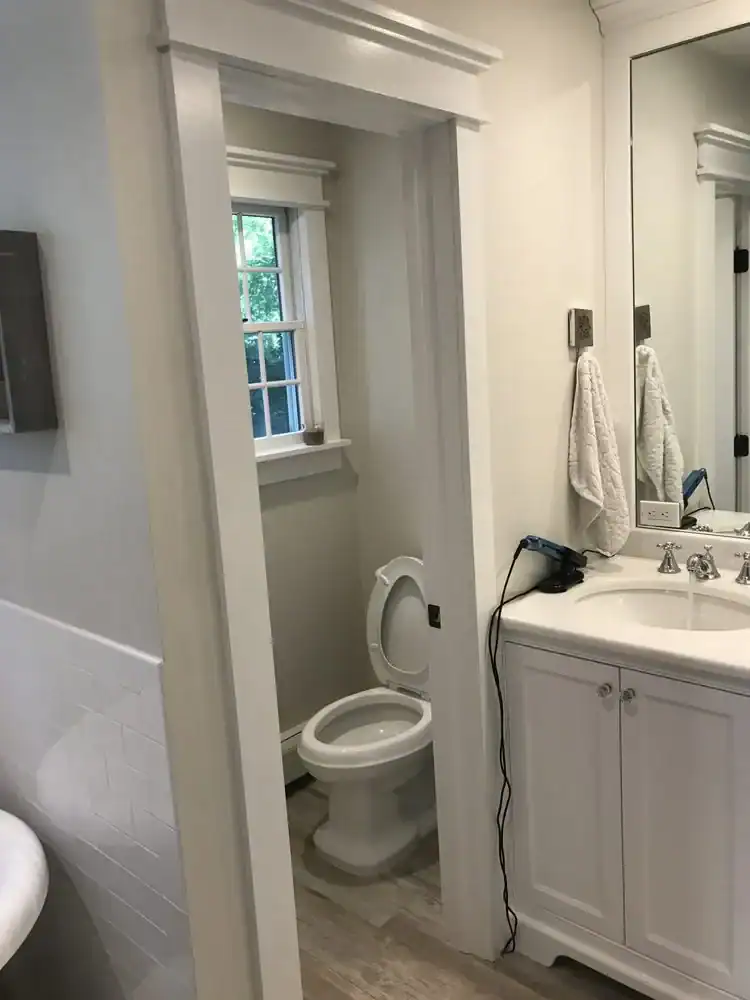
Here’s how the labor and materials split typically shakes out in a Nassau County bathroom remodel. For a mid-range project around $18,500, you’re looking at roughly $10,000 to $12,000 in labor and $6,500 to $8,500 in materials. That’s not exact math because every project is different, but it gives you a realistic starting point.
Labor costs include your general contractor’s oversight (10-20% of total project cost), plumbers at $45 to $200 per hour, electricians at $50 to $150 per hour, and tile installers who might charge $8 to $20 per square foot depending on complexity. A primary plumbing job alone can require 46 hours and run $2,000 to $3,000. Electrical work for new lighting, outlets, and ventilation fans adds another layer of cost.
Materials break down across several categories. Fixtures and fittings—which include your toilet, sink, faucets, shower or tub, and hardware—typically eat up 25-30% of your material budget. Tile and flooring take another chunk. Vanities and countertops represent 10-20% of material costs. Then you’ve got the less visible stuff: waterproofing membranes, backer boards, grout, adhesive, paint, and all the small pieces that add up.
Here’s where homeowners get into trouble: underestimating how quickly material costs stack up. You pick a $200 vanity, a $150 toilet, a $500 shower insert, and think you’re being budget-conscious. Then you add tile at $5 per square foot times 100 square feet, plus labor to install it, plus grout and adhesive, plus flooring, plus lighting fixtures, plus a mirror, plus hardware. Suddenly your “budget” bathroom makeover is pushing $15,000.
The key is knowing where you can save and where you shouldn’t. Splurging on a high-end freestanding tub when you take showers 99% of the time? Probably not the best use of funds. Investing in quality waterproofing and proper ventilation? That’s money well spent that prevents expensive problems later.
Labor is one area where cutting corners backfires. Sure, you could hire the cheapest contractor you find, but cheap labor often means inexperienced labor, which means mistakes that cost more to fix than you saved. On Long Island’s competitive market, you get what you pay for. Contractors who answer their calls, show up when they say they will, and do quality work that passes inspection? They charge accordingly, and they’re worth it.
Let’s talk about the costs nobody wants to think about but everyone has to deal with. First up: permits. In Nassau County, ALL bathroom remodeling projects require permits, regardless of how small the scope. That’s not a suggestion. It’s a requirement enforced by the Nassau County Department of Public Works, and ignoring it can result in fines, legal action, and serious headaches when you try to sell your home.
Permit fees in Nassau County range from a minimum of $75 to a maximum of $3,500, depending on the scope and cost of your project. Any electrical or plumbing work must be done by licensed professionals, and structural changes need approval. Your contractor should handle pulling permits and closing them out after inspections, but you’re paying the fees. Factor that into your budget from day one.
Demolition is another line item people underestimate. Gutting an old bathroom costs $1,000 to $2,500 on average in Nassau County. That includes removing old fixtures, tile, flooring, and sometimes drywall, plus disposal fees for all that material. Dumping fees average around $370 in New York. If your bathroom has extensive tile work or custom built-ins, demo costs sit on the higher end.
Here’s where things get real: hidden issues. Demolition almost always uncovers something. Water damage is incredibly common in bathrooms because moisture finds its way into places it shouldn’t. Mold remediation and water damage repair average $3,702 in New York, but prices vary widely depending on severity. Plumbing that needs updating to current code. Electrical wiring that’s outdated or unsafe. Subfloor damage from years of slow leaks nobody noticed.
This is why every budget guide tells you to set aside a 10-20% contingency fund. It’s not pessimism. It’s practical planning based on what actually happens when you start opening walls in older homes. A $20,000 bathroom remodel should have $2,000 to $4,000 in reserve for surprises. If you don’t need it, great. But if you do need it and don’t have it, your project grinds to a halt while you scramble for financing.
One more hidden cost: timeline delays. Permit approvals take time. Inspections need to be scheduled. Materials get backordered. Weather affects timelines, especially during Long Island winters when frozen pipes and harsh conditions can slow work. Every delay potentially means more labor costs if you’re paying contractors by the hour or day. Planning for a 4-7 week timeline is realistic for a standard bathroom. Complex projects can stretch 6-10 weeks or more.
The contractors who are upfront about these costs from the beginning are the ones worth working with. If someone gives you a rock-bottom estimate that doesn’t mention permits, doesn’t include demolition, and doesn’t account for potential issues behind the walls, that’s a red flag. You want the contractor who says “here’s what this will cost, here’s what might come up, and here’s how we’ll handle it if it does.” That’s transparency, and that’s what prevents your $15,000 project from becoming a $30,000 nightmare.
You’ve got the numbers now. You know what bathroom remodels actually cost in Nassau County, from compact 5×7 spaces to full-scale renovations. You understand the breakdown between labor and materials, the permit requirements you can’t skip, and the hidden costs that catch unprepared homeowners off guard.
Here’s what matters most: realistic budgeting and honest contractors. Set your budget based on real numbers, not wishful thinking. Include that 10-20% contingency fund. Get detailed estimates that break down labor, materials, permits, and potential issues. And choose a contractor who answers every time you reach out, responds to texts, keeps job sites clean, and has 50+ years of proven experience handling Long Island’s unique challenges.
For over five decades, we’ve been helping Nassau County homeowners navigate bathroom remodels with transparent pricing, exceptional customer service, and the kind of expertise that only comes from being a fully licensed, family-owned business where the owner works on-site. Whether you’re planning a simple bathroom makeover or a complete renovation, starting with honest information and a contractor you can actually reach makes all the difference.
Summary:
Share: