Nassau County renovation costs look nothing like what you'll find on national sites. Here's what projects actually cost on Long Island in 2026.
You did the research. You found articles saying a bathroom remodel costs $12,000 or a kitchen comes in around $30,000. Then a Nassau County contractor handed you a quote for $28,000 just for the bathroom, and suddenly you’re wondering if someone made a mistake. Nobody made a mistake. National cost averages are built from data across every market in the country — including places where labor is cheap and homes were built last decade. Long Island is neither of those things. This guide gives you the actual numbers for Nassau County in 2026, explains why they look the way they do, and helps you figure out what a realistic budget actually needs to cover.
The gap between national cost estimates and Long Island reality isn’t a rounding error — it’s structural. Labor in Nassau County runs close to New York City rates, which are among the highest in the country. Material delivery costs more. Permit requirements vary by municipality and add time and fees that don’t exist in simpler markets.
Most importantly, the housing stock itself creates costs that newer markets simply don’t have. The majority of Nassau County’s homes were built between the late 1940s and early 1970s — the Cape Cods and ranches that defined the post-war suburban expansion. Those homes are now 50 to 75 years old.
When you open the walls of a 1958 Levittown-era house, you’re likely to find knob-and-tube wiring, galvanized steel pipes, original plumbing fixtures, and in some cases, asbestos-containing materials in floor tiles or pipe insulation. These aren’t rare surprises. They’re the norm. Any honest cost estimate for a Nassau County renovation has to account for that reality.
One of the most consistent mistakes Nassau County homeowners make when budgeting a renovation is treating the contractor’s initial estimate as the final number. It rarely is — and the reason isn’t always the contractor’s fault.
When you open walls in a home built in the 1950s or 1960s, you find things. Sometimes it’s a plumbing line that hasn’t been touched since Eisenhower was president. Sometimes it’s an electrical panel that can’t support a modern kitchen. Sometimes it’s subfloor rot under a bathroom that’s been slowly leaking for years. None of these things show up on a surface inspection, and none of them can be responsibly ignored once they’re visible.
A newer home in solid condition might only need a 10 to 15 percent contingency built into the budget. An older Nassau County home — and most of them are older — should have 20 to 25 percent set aside. That’s not pessimism. That’s experience talking.
The other piece of this is permit complexity. Nassau County doesn’t operate on a single permit system. The Town of Hempstead, the Town of North Hempstead, and the Town of Oyster Bay each run their own building departments. Dozens of incorporated villages — Garden City, Rockville Centre, Lynbrook, Valley Stream, and others — have their own permit offices entirely separate from the towns. A contractor who isn’t deeply familiar with your specific municipality can create costly delays just by filing in the wrong place or missing a local requirement. That local knowledge isn’t a luxury. It’s part of what you’re paying for when you hire someone who has been working in Nassau County for decades.
Some contractors deliberately bid low to win the job. It’s not a mistake or an oversight — it’s a strategy. They quote a number they know will look attractive, get you to sign, and then recover their margin through change orders once work is underway. By that point, stopping mid-project creates its own costs and complications, so most homeowners feel trapped and pay.
This pattern is documented enough that it has a name in the industry. On Long Island, where over 20 percent of bathroom remodels end up over budget when contractors rely on vague verbal quotes, it’s not a fringe problem.
The way to protect yourself is straightforward. Get a written, itemized estimate — not a ballpark over the phone and not a single-line total. A legitimate estimate breaks down labor, materials, and scope clearly enough that you can compare it line by line against other quotes. If one contractor is quoting $19,000 and another is quoting $38,000 for what sounds like the same bathroom, the difference is almost certainly in what’s included, not in how generous one contractor is feeling. The lower quote may exclude tile removal, subfloor inspection, permit fees, or fixture installation. The higher quote may include all of it. You can’t know unless it’s written down.
A written estimate also gives you legal footing if the project goes sideways. Verbal agreements are nearly impossible to enforce. A detailed contract that defines scope, timeline, materials, and payment schedule is the baseline expectation from any contractor worth hiring — not a special request.
Want live answers?
Connect with a Ray Coleman expert for fast, friendly support.
A small bathroom remodel is one of the most common projects Nassau County homeowners ask about, and one of the most consistently misunderstood in terms of cost. National articles put the average bathroom remodel somewhere around $12,000. On Long Island, that number doesn’t get you very far.
For a small bathroom — typically 40 to 50 square feet — a meaningful update in Nassau County starts around $15,000 and can run $25,000 or more depending on how much of the room you’re touching. That range assumes you’re keeping plumbing in its current location. The moment you start moving drains or supply lines, costs climb quickly, and a mid-range full bathroom renovation can land between $25,000 and $40,000. A primary bathroom with custom tile, a double vanity, and a luxury shower can run $40,000 to $75,000 or higher.

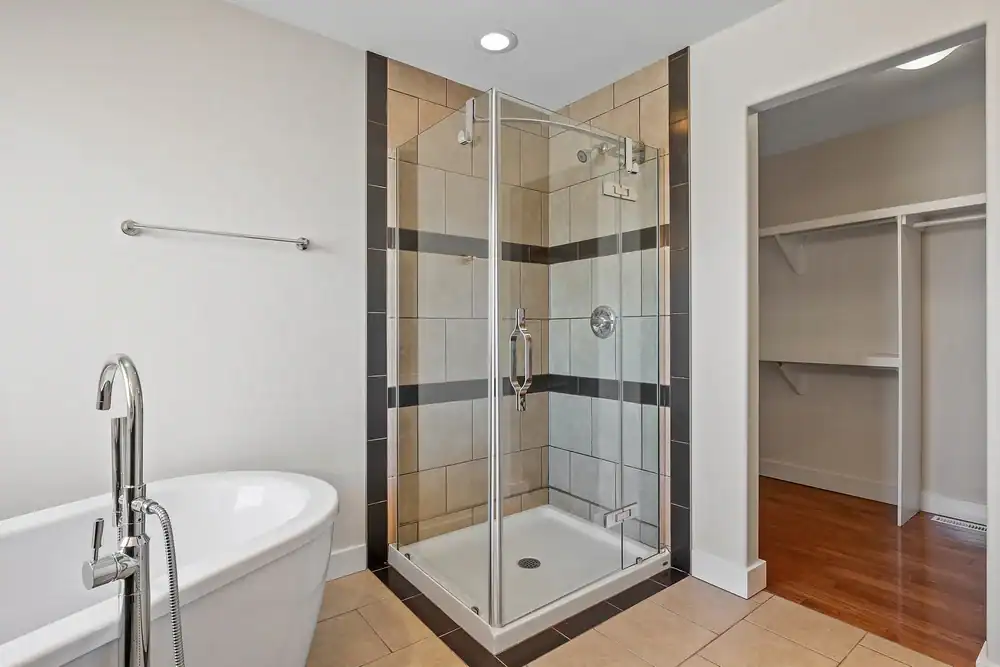
Converting a bathtub to a walk-in shower is one of the most popular bathroom projects in Nassau County right now, especially in older homes where the original tub layout no longer fits how the family actually uses the space. Nationally, you’ll see this project quoted around $3,000 on average. On Long Island, a tub to shower conversion typically costs between $10,000 and $20,000.
The reason for that gap is the work involved. A tub-to-shower conversion isn’t just swapping one fixture for another. It requires modifying the drain location, installing proper waterproofing behind the walls, tiling the shower surround, and typically adding a glass door or enclosure. If you want a frameless glass door and a rain head, you’re toward the higher end of that range. If you’re keeping the footprint simple and choosing mid-range tile, you can come in closer to the lower end.
The age of Nassau County homes adds another variable. In a 1960s bathroom, the subfloor under the tub area may have moisture damage that’s been accumulating for years. Once the tub comes out, that damage becomes visible — and it has to be addressed before anything new goes in. This is exactly the kind of discovery that a 20 to 25 percent contingency is meant to cover.
One thing worth knowing: the scope of this project, and whether it requires a permit, depends on your specific municipality in Nassau County. Some villages handle this differently than the towns. A contractor who knows your local jurisdiction can tell you upfront what’s required and factor that into the timeline and budget before you commit.
These two projects sound similar but they’re not the same thing, and the cost difference reflects that.
A bath to shower conversion means you’re removing an existing bathtub and building a shower in that footprint or a modified version of it. As covered above, that typically runs $10,000 to $20,000 on Long Island because of the plumbing work, waterproofing, and tile installation involved.
A shower replacement is a different scope. Here, you already have a shower — you just want to replace it. Maybe the tile is cracked, the pan is stained, or the whole enclosure looks dated. Because you’re not moving plumbing or changing the footprint, the work is less involved. On Long Island, a shower replacement typically runs $8,000 to $18,000 depending on the size of the shower, the tile you choose, and whether you’re replacing the enclosure and door along with the wet area.
The reason shower replacement still costs more than many homeowners expect is tile labor. In Nassau County, tile installation labor alone runs $8 to $15 per square foot. Add the cost of the tile itself, the waterproofing membrane, grout, and a new frameless glass enclosure if that’s the direction you’re going, and the numbers add up faster than the national averages suggest. A custom walk-in shower with tile walls, a frameless glass door, and a rain head fixture typically costs $6,000 to $15,000 just for the wet area — before you factor in any surrounding bathroom work.
The practical takeaway is this: if you’re budgeting a bathroom project in Nassau County, start from local numbers, not national ones. Build in your contingency. And get a written estimate that spells out exactly what’s included so you’re comparing apples to apples when you talk to more than one contractor.
The single most useful thing you can do before starting any renovation in Nassau County is get a written, itemized estimate from a contractor who actually knows this market — not a national franchise, not someone who drove in from three counties away, but someone who has been working in these homes and dealing with these municipalities for years.
Long Island renovation costs are what they are because of real factors: labor rates, aging housing stock, local permit complexity, and the genuine discoveries that come with opening walls in a 50-year-old home. A contractor who gives you a number that sounds too good relative to everyone else is either missing something or planning to find it later.
If you’re planning a kitchen remodel, bathroom renovation, first-floor update, dormer, or home extension in Nassau County and want a straight answer about what it’s going to cost, we’re happy to walk through it with you. Ray Coleman Home Improvement has been doing this work on Long Island since 1972, and we’re still here — still answering the phone, still showing up.
Summary:
Share: