Trying to decide between an outdoor kitchen and a deck addition for your Nassau County home? Here's what the real costs look like — and what survives a Long Island winter.

You’ve probably seen the national averages. Outdoor kitchen: $13,000 to $16,500. Deck addition: somewhere in that same range. Then you started calling contractors in Nassau County and realized those numbers don’t quite apply here.
That’s not a coincidence. Nassau County has its own labor market, its own permit landscape, and winters that have a way of destroying outdoor structures that weren’t built with them in mind. If you’re trying to figure out which project makes sense for your backyard — and what it’s actually going to cost — this is the comparison that starts with Long Island, not Dallas.
The gap between a national estimate and a real Nassau County outdoor kitchen cost isn’t small. Hidden costs alone — utility runs for gas or water, permit fees, site-specific prep work — routinely add $3,000 to $10,000 above whatever baseline you’ve been reading about. A complete custom build on Long Island typically lands somewhere between $15,000 and $35,000, depending on size, appliances, and finishes.
That range exists for a reason. A basic setup with a built-in grill, some counter space, and a modest footprint is a very different project than a full outdoor kitchen with a pizza oven, refrigerator, sink, bar seating, and a pergola overhead. The appliances alone can move the number dramatically — and in Nassau County, the appliances you choose matter more than they would in warmer climates.

Here’s the part most national content skips entirely: Nassau County’s climate is genuinely hard on outdoor kitchens. Freeze-thaw cycles run from November through March. If you’re anywhere near the South Shore — Wantagh, Seaford, Massapequa, Bellmore, Merrick — you’re also dealing with salt air off the Great South Bay that accelerates corrosion on anything metal that wasn’t specified for coastal conditions.
A contractor who builds outdoor kitchens in Phoenix or Atlanta can use materials that would fail here after one or two winters. Porous countertop materials absorb water, freeze, and crack. Standard wood cabinetry warps and rots. Appliances that aren’t rated for coastal environments corrode fast enough that you’re looking at replacements within three to five years.
The difference between a kitchen that looks great in photos and one that’s still functioning a decade later comes down to decisions made at the design stage — sealed natural stone or granite for countertops, stainless steel appliances rated for outdoor and coastal use, and cabinetry built specifically for the conditions it’ll face.
This is also why the Northeast labor premium exists. You’re not just paying for installation — you’re paying for someone who understands what Long Island winters do to outdoor structures and specs the project accordingly. Footings need to reach below the frost line, which in Nassau County means roughly 36 to 42 inches down. Skip that step and you’ll watch a masonry island shift and crack as the ground heaves and settles each season.
Granite countertops installed on Long Island run roughly $60 to $120 per square foot. That’s a wide range, and it reflects real variation in stone selection and edge profiles — but it’s also just the reality of what quality material costs in this market. Trying to shave cost by going with something cheaper is usually where the regret starts.
This is the objection that comes up constantly, and it’s worth addressing directly: outdoor kitchens in the Sun Belt return roughly 120% of their cost at resale. In the Northeast, that number drops to somewhere between 50% and 80%. If you’re comparing those figures side by side, the Northeast looks like the worse investment.
But that framing leaves out a few things. First, homes with outdoor kitchens on Long Island sell 23% faster than comparable homes without them — and in a market where carrying costs are real, faster is worth something. Second, a post-pandemic National Association of Realtors survey found that outdoor kitchens can deliver 100% cost recovery at resale when the project is done well and the materials hold up. Third, the lifestyle value of five to six months of outdoor cooking and entertaining without running back inside isn’t nothing. Add a covered structure and patio heaters and that season stretches further.
The comparison that actually matters isn’t outdoor kitchen ROI in Nassau County versus Florida — it’s outdoor kitchen versus the other things you could do with that budget. Pools, for instance, can return as little as 7% at resale. A well-built outdoor kitchen almost always outperforms that. A well-maintained yard, broadly speaking, can increase a home’s value by 10 to 12%, and an outdoor kitchen amplifies that effect.
The honest answer is that an outdoor kitchen in Nassau County is a real investment with real returns — but only if it’s built with the right materials for this climate. A kitchen that fails after two winters doesn’t return anything.
Want live answers?
Connect with a Ray Coleman expert for fast, friendly support.
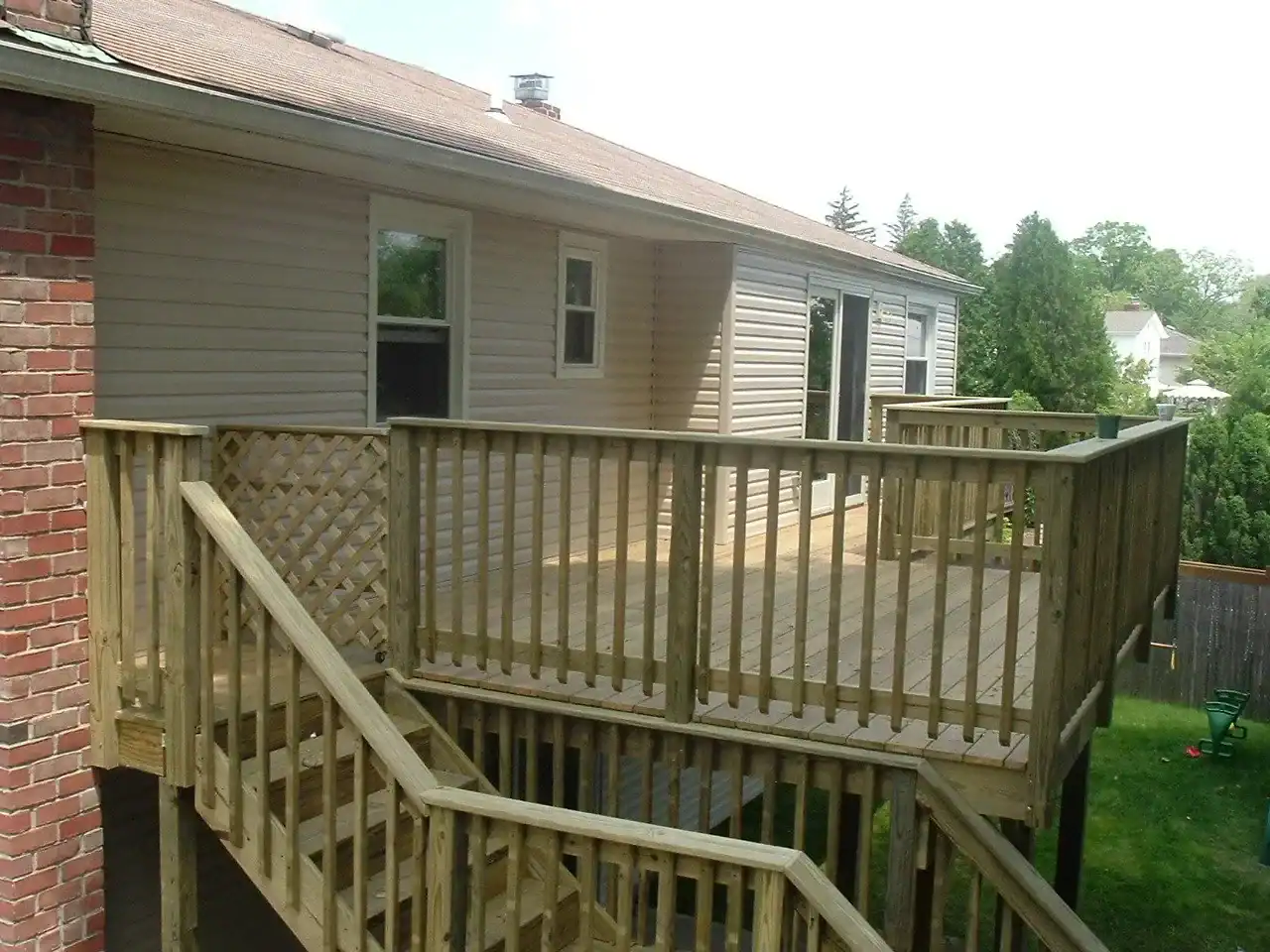
Deck additions in Nassau County typically run between $3,490 and $19,628 depending on size, materials, and complexity. A 16-by-20-foot wood deck nationally averages around $18,263 — composite comes in higher, around $25,096 — but those figures assume average labor costs, and Long Island labor costs are not average.
Pressure-treated wood is the lower-cost entry point. Composite decking runs roughly 40% more than wood but holds up significantly better over time, especially in a climate that cycles between humidity in summer and deep freezes in winter. For most Nassau County homeowners, composite is the smarter long-term choice even if the upfront number is harder to swallow.

They’re not always competing choices. For a lot of Nassau County homeowners, the real question isn’t outdoor kitchen or deck — it’s whether to plan both together from the start or do one now and add the other later.
The “add it later” approach sounds reasonable until you think through the structural reality. An outdoor kitchen isn’t something you drop onto an existing deck as an afterthought. Gas lines, electrical connections, plumbing, and the load-bearing capacity needed for masonry construction all need to be planned at the framing stage. Retrofitting those elements into a deck that wasn’t designed for them is significantly more expensive and disruptive than getting the planning right the first time.
If there’s any chance you want an outdoor kitchen within the next five to ten years, it’s worth having that conversation before the deck goes in. If your budget genuinely only allows for one right now, a well-built deck with composite decking is a solid investment that adds usable square footage and holds up through Long Island winters. It also returns a meaningful percentage of its cost at resale — a wood deck recoups over 50%, composite over 40% — and it gives you a functional outdoor space while you plan the next phase.
The homeowners who tend to regret their decision are the ones who built a deck without thinking about the outdoor kitchen, then discovered mid-project that the gas line would need to run 40 feet from the house and the existing framing couldn’t support the weight of a masonry island. Planning both at once, even if you’re only building one at a time, saves real money and real headaches.
Nassau County is a competitive contractor market, and that’s not a secret. What that actually means for homeowners is that you’ll encounter a wide range of quality, responsiveness, and honesty — sometimes within the same week of making calls. Knowing what separates a contractor who’s right for this kind of project from one who isn’t is worth understanding before you start.
Licensing is the baseline. Nassau County requires home improvement contractors to be licensed under Chapter 21 of the Nassau County Administrative Code, and those license numbers are publicly verifiable at the Nassau County Office of Consumer Affairs. This isn’t a formality — homeowners who hire unlicensed contractors for permitted work carry the liability themselves. Ask for license numbers and verify them.
Permits are the next layer. Every new deck in Nassau County requires a building permit, regardless of size. Outdoor kitchens with gas, electrical, or plumbing connections require permits too. Nassau County’s multi-municipality structure — three towns, dozens of incorporated villages, each with its own building department — makes the permitting process genuinely complicated for homeowners who try to navigate it themselves. A licensed contractor files as the agent of record and manages the process. That’s not a minor convenience; it’s the difference between one phone call and four trips to the building department.
Beyond credentials, the things that actually predict a good experience are simpler: Does the contractor answer the phone? Do they give you a written estimate with specific line items, not vague categories that leave room for change orders later? Is someone with real accountability on your job site every day, or are they sending a crew and checking in occasionally?
We’ve been building in Nassau County since 1972. Over 60% of our work comes from referrals, which is the number that matters most to us — it means the people we’ve built for are comfortable putting their name behind the recommendation. Ray Coleman and his son work on-site personally, every day, on every project. When you call, someone answers. When we give you a number, that’s the number.
If you want to be using an outdoor kitchen or a new deck by Memorial Day, fall is when the planning needs to happen. Spring is when contractor calendars fill up and permit timelines extend. The homeowners who get exactly what they wanted, built right and on schedule, are almost always the ones who started the conversation in the fall.
The decision between an outdoor kitchen and a deck addition doesn’t have to be either/or — but it does have to be informed. National cost estimates won’t prepare you for what projects actually cost here. Generic contractor advice won’t tell you what Nassau County’s freeze-thaw cycles will do to the wrong materials. And a vague estimate from a contractor you can’t reach won’t protect you when the bill comes in.
If you’re ready to talk through what makes sense for your backyard, your budget, and your timeline, reach out to Ray Coleman Home Improvement. We’ll give you a straight answer.
Summary:
Share: