Nassau County has its own rules for permits, contractor licensing, and consumer protections. Here's what every homeowner should know before starting a renovation.
If you’re planning a kitchen remodel, bathroom renovation, or a larger project like a dormer or first-floor overhaul, Nassau County has some rules worth knowing before you pick up the phone. The permit system here works differently than most homeowners expect. Contractor licensing is handled locally, not by New York State. And the consequences of getting either one wrong — unpermitted work, an unlicensed contractor — can follow your home for years.
None of this has to be complicated. Once you understand how the system is set up, it’s actually pretty straightforward. Here’s what you need to know.
Here’s the thing most homeowners don’t realize: Nassau County doesn’t issue building permits directly. Depending on where your home sits, permits are issued by the Town of Hempstead, the Town of North Hempstead, the Town of Oyster Bay, the City of Long Beach, the City of Glen Cove, or potentially your individual village — and Nassau County has approximately 64 incorporated villages, each with its own rules.
That matters because permit requirements, processing times, and inspection procedures can vary based on your exact address. A project that sails through in one municipality might require additional documentation in another. If you’ve ever asked a contractor “do I need a permit for this?” and gotten a vague answer, this is usually why — the honest answer depends on where you live in Nassau County, not just what you’re doing.
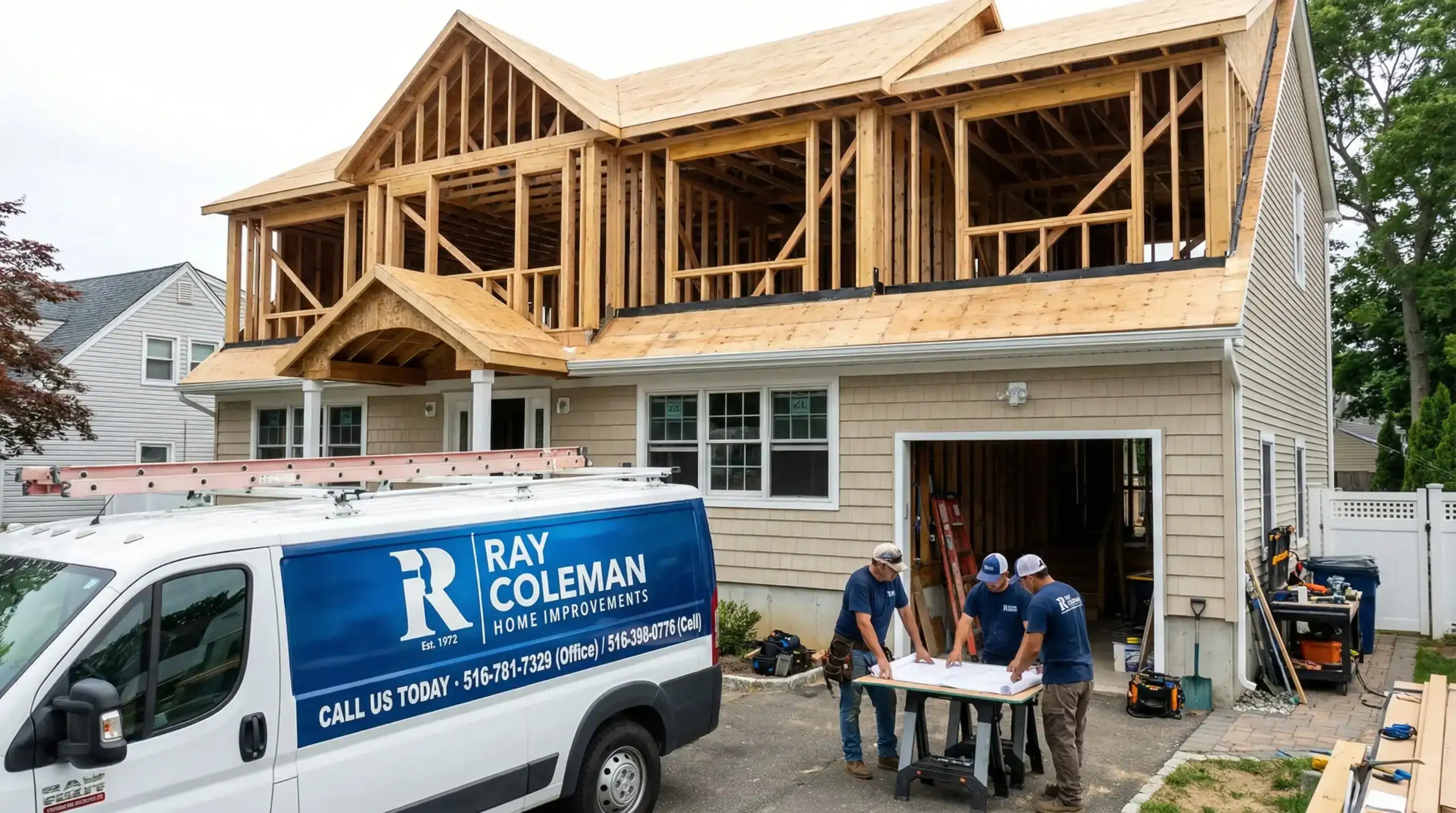
The general rule is this: if you’re changing the structure of your home, modifying its footprint, or altering its electrical or plumbing systems in a meaningful way, you need a permit before work begins. That includes removing load-bearing walls, adding a dormer, building an addition, finishing a basement, or installing a second-floor addition.
Any work that changes how your home is built — not just how it looks — falls into permit territory. Electrical and plumbing work follows the same logic. If you’re adding new circuits, relocating plumbing lines, or making changes that go beyond swapping out a fixture, your municipality will want to know about it before the walls close up.
What typically doesn’t require a permit is cosmetic work. Replacing kitchen cabinets, installing new countertops, retiling a bathroom, updating flooring, swapping out fixtures — these projects generally don’t trigger permit requirements because they don’t affect the structure or systems of the home.
This is worth understanding clearly, because a lot of homeowners assume that any large renovation automatically requires permits. That’s not true. A full kitchen remodel that involves new cabinets, countertops, flooring, and appliances — but no structural changes and no new electrical circuits — often doesn’t require a permit at all. The scope of the work determines the requirement, not the dollar amount or the scale of the project.
Even if your contractor pulls the permits, the consequences of unpermitted work land on you as the homeowner. Unpermitted work can complicate or block a home sale, trigger fines, require demolition of completed work, and create problems with your homeowner’s insurance. You are responsible for making sure proper permits are obtained before work starts, even if your contractor is handling the paperwork.
The average single-family home in Nassau County is 73 years old. That places the typical Nassau County house squarely in the post-World War II building boom — the era of Cape Cods and ranch homes that went up by the thousands in places like Levittown, Wantagh, Merrick, and Bellmore starting in the late 1940s. Levitt & Sons alone built over 17,000 homes on former potato fields in the Town of Hempstead between 1947 and 1951.
Those homes were built well for their time. But 70-plus years of living, patching, and updating means that opening a wall in a Nassau County Cape Cod can reveal surprises — older wiring, galvanized pipes, insulation that doesn’t meet current standards, or structural configurations that weren’t designed with modern open-concept layouts in mind. None of that is disqualifying. It just means the contractor you hire needs to know what they’re looking at.
This is also why permit requirements matter more in older homes than newer ones. Pre-1978 construction means lead paint is a real possibility, and contractors working on those homes are required by federal law to complete an EPA-approved Lead Safety for Renovation, Repair & Paint (RRP) course. It’s not optional, and it’s not a formality — it’s a legal requirement designed to protect your family during renovation work.
For homeowners in Nassau County’s established neighborhoods, the age of the housing stock isn’t a problem. It’s just context. The right contractor has seen these homes before, knows what to look for, and won’t be caught off guard when the original 1950s plumbing shows up behind the kitchen wall.
Want live answers?
Connect with a Ray Coleman expert for fast, friendly support.
New York State does not issue a statewide general contractor license. That surprises a lot of people. In Nassau County, the relevant license comes from the Nassau County Office of Consumer Affairs, and it’s required by law under Nassau County Administrative Code Section 21-11. Operating a home improvement business in Nassau County without that license is illegal — not a gray area, not a technicality.
The OCA administers more than 10,000 licenses across 15-plus categories, and home improvement is one of the largest. Licensed contractors are required to carry liability insurance, workers’ compensation, and bonding. Their subcontractors — with the exception of licensed plumbers and electricians — must also hold valid Nassau County Consumer Affairs licenses.
Verifying a contractor’s license in Nassau County is simple. Call the Office of Consumer Affairs at 516-571-2600. Give them the contractor’s name or business name, and they can confirm whether the license is active and whether there are any complaints on record. You can also visit their office at 200 County Seat Drive in Mineola. It takes five minutes and it’s the single most important thing you can do before signing anything.
Why does this matter so much? Because Nassau County has a documented history of unlicensed contractors taking advantage of homeowners — particularly after major storms. Following Superstorm Sandy, Nassau County arrested 61 unlicensed contractors who were preying on storm-damaged homeowners, many of whom took deposits and disappeared. In a separate enforcement operation, 51 individuals faced criminal charges, including four charged with Grand Larceny for allegedly stealing more than $150,000 from homeowners.
These aren’t isolated incidents. The pattern is consistent: unlicensed, uninsured operators appear during periods of high demand, take money upfront, and vanish. A licensed contractor operating under Nassau County OCA oversight has real accountability — their license can be revoked, complaints are investigated, and there’s a formal mediation process available to homeowners who have disputes.
There’s also the Nassau County Restitution Fund, which exists specifically to compensate homeowners who obtain a legal judgment or arbitration award against a licensed contractor and can’t collect. That protection only applies if the contractor was licensed. If you hire someone without a valid OCA license and something goes wrong, you’re largely on your own.
Nassau County law requires a written contract for home improvement work. If a contractor resists putting things in writing — scope of work, timeline, payment schedule — that’s a serious red flag. The contract isn’t just a formality; it’s your legal protection and a requirement under Nassau County Administrative Code.
The Nassau County home improvement market is competitive. There are hundreds of contractors operating across the region, and the gap between the best and worst is enormous. Knowing what separates a reliable contractor from a risky one matters more here than in markets where licensing is handled at the state level and easier to verify.
Beyond the OCA license check, there are a few things worth paying attention to. Does the contractor answer the phone? It sounds basic, but in this market, responsiveness is genuinely rare and genuinely telling. A contractor who picks up on the first call, responds to texts, and shows up on time for an estimate is demonstrating something about how they’ll run your project before a single tool comes out.
Ask whether the owner will be on-site during the work. On larger projects — kitchen remodels, bathroom renovations, dormers, first-floor renovations — daily owner presence means consistent oversight and faster problem-solving when something unexpected comes up. It’s the difference between a contractor who manages your job and one who manages your job from a distance.
Get a detailed written estimate. Not a ballpark number scrawled on a business card — a line-item breakdown of scope, materials, and payment schedule. Compare estimates carefully. A dramatically low bid from an unlicensed contractor isn’t a deal; it’s a liability. Ask directly: what does your estimate include, and what would cause the final number to change? A contractor who can answer that question clearly and confidently is one who understands the project. One who hedges or deflects is one who may be padding room for change orders later.
Finally, ask about job site management. For homeowners living in the home during a renovation — which is most Nassau County homeowners — daily cleanup matters. Construction dust and debris are part of the process, but they don’t have to take over your house for the duration of the project.
Nassau County’s permit system, contractor licensing requirements, and older housing stock create a specific set of considerations that don’t apply everywhere. But none of it is overwhelming once you understand how it works.
Know which municipality issues your permits. Verify your contractor’s OCA license before signing anything. Get a written contract. And make sure the person you hire has actually worked on homes like yours — 1950s Cape Cods and ranches that have their own quirks and their own history.
If you’re planning a kitchen remodel, bathroom renovation, dormer, or larger whole-house project in Nassau County, we’ve been doing this work in these neighborhoods since 1972. Ray Coleman Home Improvement is licensed, insured, and bonded in both Nassau and Suffolk County — and we answer the phone. Call us, send a text, or reach out to get started.
Summary:
Share: